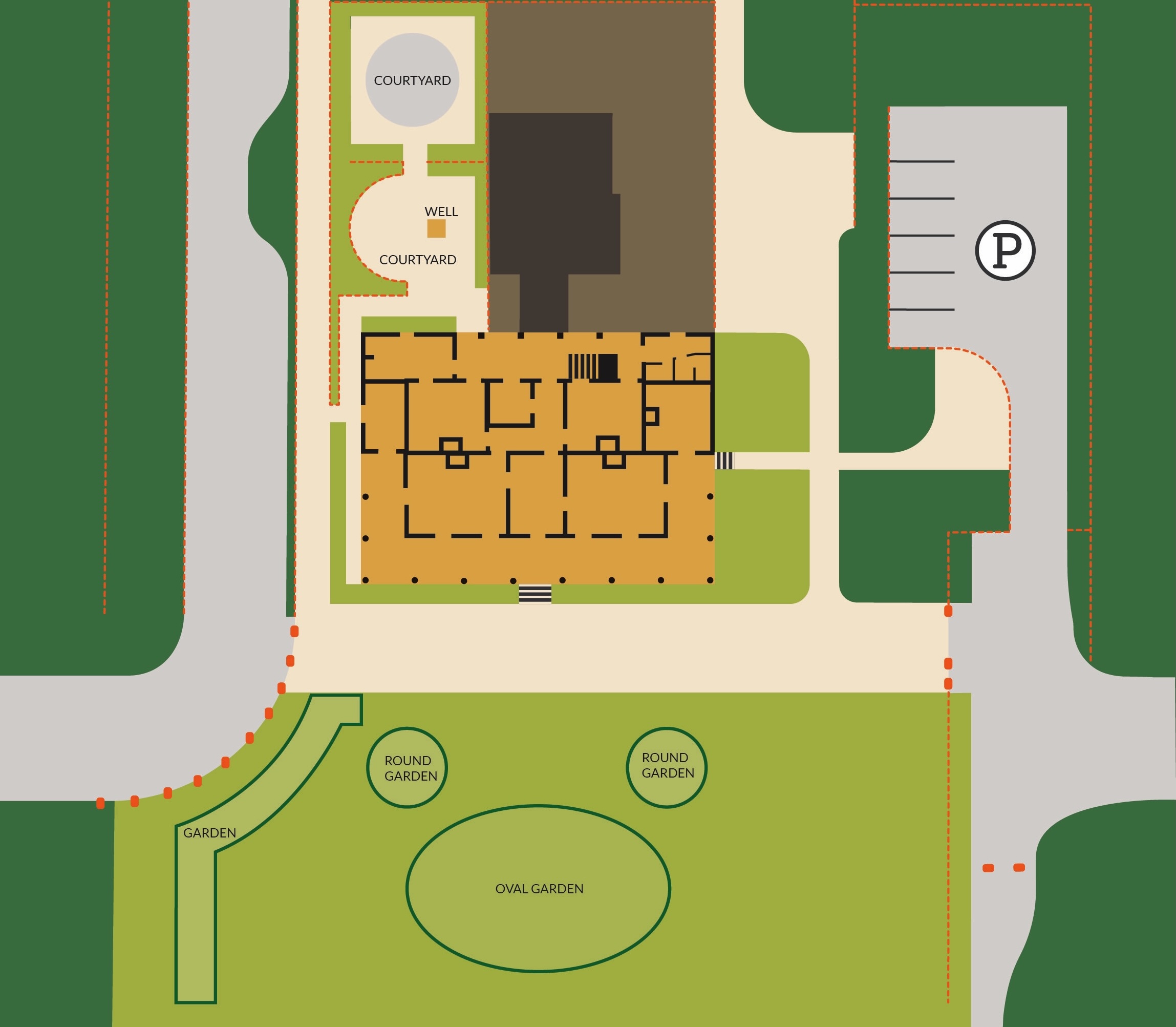
The Verandah — direct address, looking out over the park
Elizabeth Ruse arrived in the colony in 1790 and lived through the years when this farm was the centre of a desperate experiment. In this audio stop, she steps forward to speak directly to you: her fears, her labour, and the quiet endurance that rarely made it into the historical record.
Her visit is imagined, but her world is not. The details she describes — the crops, the rations, the brick house, the grant — come straight from the historical record of Ruse Farm and early Parramatta.
Stand on the verandah at the front of the cottage, facing out across the park.
Transcript
Elizabeth Ruse
Look out at the park. All that green. I need you to see wot it was.
Elizabeth Ruse
Stumps. Burned earth. A slab 'ut. And a question the 'ole colony was waitin' on: could one man — one convict done 'is time, given a bit of cleared ground and eighteen months — feed 'imself out of it. If 'e couldn't, none of us could. That was the experiment.
Elizabeth Ruse
Me name's Elizabeth. I come out on the "Lady Juliana" in 1790. Never put me 'and to a plough in me life before that. James — me 'usband — 'e 'ad, back in Cornwall. We learned the rest by failin' and tryin' again before the failin' finished us.
Elizabeth Ruse
There was fings I never said out loud. That I 'ad the fear of snakes somethin' terrible. That the maize'd fail on us.
Elizabeth Ruse
James, 'e was proud of 'is 'oe. Worked the ground like 'e was back in Cornwall — turn, compost the weeds in, turn again. No 'orse. No ox. Just our 'ands.
Elizabeth Ruse
Wheat wanted England — the rain it was bred for, the soil it knowed. We 'adn't got neither. Maize was kinder. So we grew maize.
Elizabeth Ruse
While James turned the ground, I done wot never got wrote down — the animals, the cookin', the clothes. Countin' the rations careful against the lean weeks.
Elizabeth Ruse
When Captain Tench come visitin', James told 'im: "I have no person to help me, at present, but my wife. She is industrious." Said it like 'e was reportin' the weather.
Elizabeth Ruse
They'd promised 'im a grant if 'e could do it.
Elizabeth Ruse
We done it. Just.
Elizabeth Ruse
Next year, the soil give out. Drought come. James sold this place to a surgeon — John 'Arris — forty pounds, and we walked west to the 'Awkesbury. Wot got remembered was the grant. The rest, mostly, didn't.
This article was narrated using AI technology.
Learn more →
Most convict ships arrived with people in appalling condition. Elizabeth's did not — and the reason was one officer who had sailed with Cook.
Transcript
Anna
I have a question about the journey on "The Lady Juliana" - Most convict
ships arrived with people in appalling condition — sick, half-starved. Yours didn't.
What was so different about that crossing?
Elizabeth Ruse
You 'eard about us, then...
Anna
A little. Enough to know it wasn't like the others...
Elizabeth Ruse
No. It weren't.
Elizabeth Ruse
The ship 'ad a government man on board — a Lieutenant Edgar. Thomas Edgar. Thomas Edgar. The man 'ad sailed wiv Captain Cook. Which meant 'e'd seen wot 'appens when you keep sailors below too long, in the dark, breathin' each uvver's air. 'E weren't about to let the same 'appen to us.
Elizabeth Ruse
We 'ad the deck. Daytime — sky, wind, the smell of open water. They fumigated below. Scrubbed it down proper. We stopped at ports — Tenerife, then Rio de Janeiro six weeks, Cape of Good 'Ope — and every one of 'em, fresh food come aboard. Fruit. Meat wot 'adn't turned. You'd be surprised wot that does. Does somethin' to a person, that does. The way you carry yourself.
Elizabeth Ruse
It was a long voyage.
Elizabeth Ruse
Two 'undred and twenty-six of us made that crossin'. Five died. Five. The ships wot come after us that same year — the Neptune, the Scarborough — they arrived wiv people so far gone the colony didn't know wot to do wiv 'em. 'Undreds dead at sea. Them wot lived was carried off. Couldn't walk.
Elizabeth Ruse
We walked off.
Elizabeth Ruse
Didn't understand at the time 'ow lucky we was. I do now.
The Brick House
Governor Phillip gave this farm a brick house while the rest of Parramatta lived in wattle and daub. Elizabeth explains what that cost the colony — and what it told her.
Transcript
Benji
I have a question about the house. Governor Phillip provided you with a brick
house — at a time when almost everyone else was in wattle and daub or canvas.
Why this farm? Why you?
Elizabeth Ruse
Before answerin' the question — d'you know wot brick meant, 'ere, in 1790?
Benji
Not really, no.
Elizabeth Ruse
Right then, let me explain this proper.
Elizabeth Ruse
The rest of Parramatta was just as you said. Sticks wove together, plastered over wiv clay, thatched on top. When it rained, the clay washed away. And it rained plenty. When it dried, it cracked. You was always patchin' it, always watchin' it. The canvas tents before that was worse. You could 'ear the wind through 'em at night.
Elizabeth Ruse
Brick was different. Brick 'eld. You could press your 'and against it in summer and feel the cool. In winter it 'eld the warmth of the fire. And it didn't rot.
Elizabeth Ruse
But 'ere's the fing about wot brick meant in 1790. The kiln at Parramatta 'ad only just been lit. There was men — convict men — 'oo spent every day of their lives makin' bricks. Thirty thousand a month, that was the target. The 'ole output of the colony. A 'ouse our size — four rooms, walls thick enough to matter, a chimney — call it twenty, twenty-five thousand bricks. Nearly a 'ole month's output of the colony!
Elizabeth Ruse
Phillip give them bricks to us. To this farm. To the experiment.
Elizabeth Ruse
That's wot it told me. Not that we was comfortable — though we was, more than most. It told me that Phillip couldn't afford for James to fail. The colony was 'ungry. The stores was low. If one man, given ground and time, couldn't feed 'imself out of it — the 'ole question of whether this place could ever sustain itself went unanswered. 'E needed an answer. So 'e built us a 'ouse that'd last, 'cause 'e needed the man inside it to last.
Elizabeth Ruse
Weren't kindness. It was calculation. Though I'll admit — on a cold night, I didn't much care which one it was.
Elizabeth Ruse
You 'ave the why and the wot of it now. I 'ope that covers wot you was after?
On fiction and historical accuracy
This stop presents a fictional scene — a character who may or may not have existed, a conversation that was never recorded, a moment invented to bring the past within reach. That is a deliberate choice. History rarely preserved the voices of the people who mattered most here: the labourers, the women, the convicts, the Dharug families whose Country this always was. Fiction lets those voices speak.
The invention, though, is held on a short leash. Every detail of setting, season, diet, law, and daily life has been checked against the historical record. Where the evidence is uncertain, we have tried to say so. Where it is solid, we have built on it faithfully.