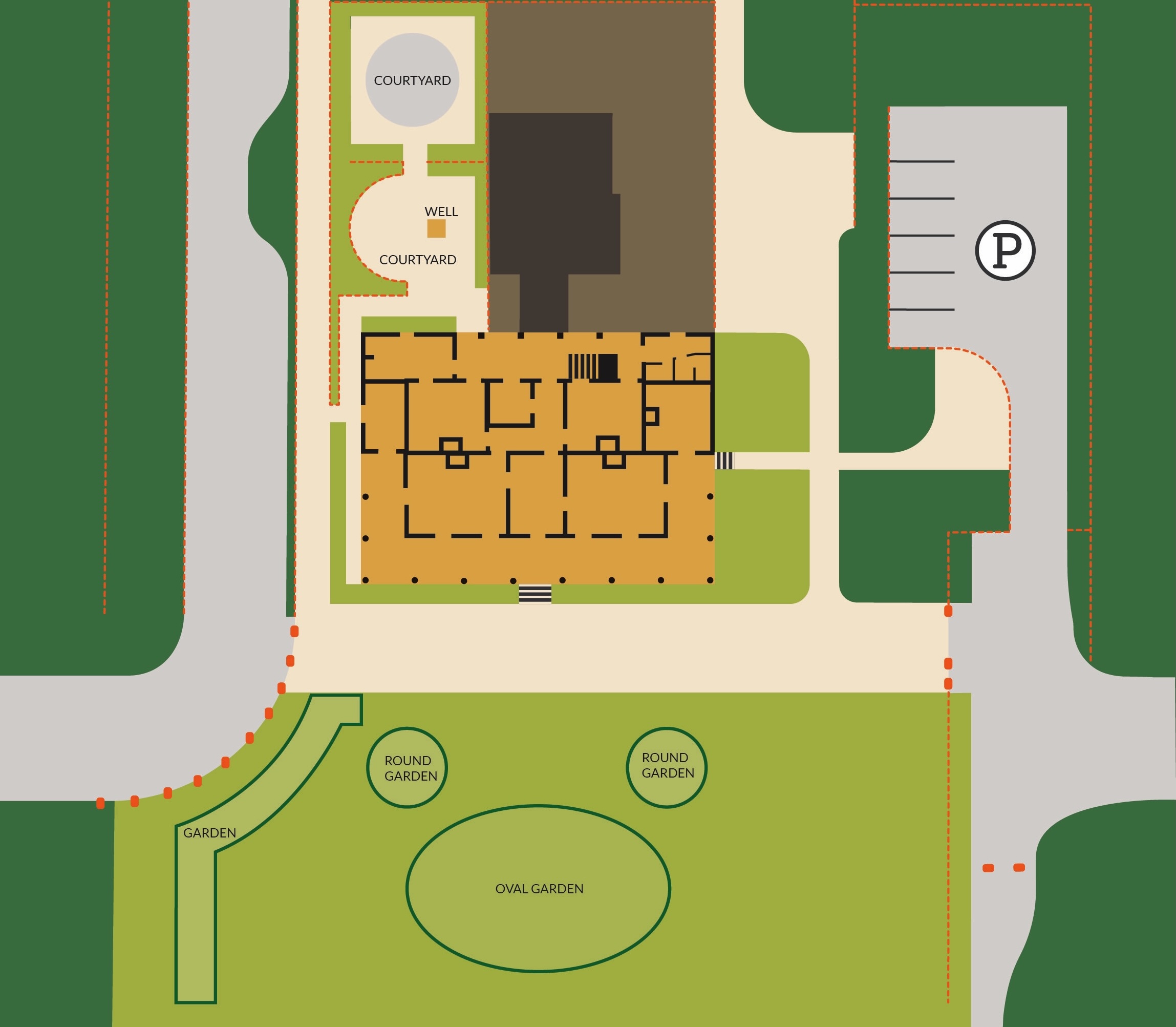
The Rear Garden — direct address, surveying the estate
John Harris was one of the colony's more prosperous men. He bought this farm from James Ruse in 1793 and built it into a substantial estate. In this audio stop, he speaks for himself: frank about his advantages, clear-eyed about what they cost others.
His visit is imagined, but his world is not. The details he describes — the purchase price, the livestock, the smallpox vaccine, the inheritance condition — are drawn from the historical record.
Walk around to the garden behind the cottage, facing out over the estate.
Transcript
John Harris
Allow me. Doctor John Harris — surgeon, Edinburgh-trained, Irish-born, ten years a navy surgeon before Sydney was a problem on a map. Later: magistrate. Naval Officer. Bank director. There. Pleasantries dispensed with.
John Harris
Elizabeth tells one part of this. I'll tell you another. Her husband sold me the farm in 1793 for forty pounds. A steal. He knew it. I knew it. We shook hands anyway.
John Harris
Look around. The brick path. The well. The walled beds — a long way from a slab hut and a stump field. By 1800 I had thirty-two thousand bricks on order, two new roofs.
John Harris
The thirty acres Ruse was given as a question — "can a man feed himself out of this?" — became part of a hundred and thirty of mine. Fenced. Sown. Stocked. Two hundred and fifty sheep. Fifty cattle. The earth that broke him hoeing it by hand fed mine handsomely.
John Harris
The neighbour over the rise was John Macarthur. We sat on the same committees, looked after the colony's morals and its sheep, and politely competed for influence. Sydney was the port. This was where the colony was deciding what kind of place it intended to be.
John Harris
I won't pretend Elizabeth's story and mine balance out. They don't. The land that broke them made me. The records kept me and lost her, and that wasn't accidental — it was the shape of how this all worked.
John Harris
That shape certainly worked for me. Ultimo House, Shane's Park. A hundred and fifty thousand pounds when I died. Eliza and I had no children. So this farm — this one, where my name began in the colony — I left to my nephew. On one condition. Every eldest son, in every generation, in perpetuity, was to be named John Harris. Or the inheritance went to whoever was. Some men leave a fortune. I left a name. Repeatedly.
This article was narrated using AI technology.
Learn more →
I have a question about the money, actually — the forty pounds.
Was that a fair price for land in the colony in 1793, or were you taking
advantage of a desperate man?
John Harris
Taking advantage? No. Taking an opportunity. Those are different things. Though I'd grant you the line is fine.
John Harris
Land in the colony in 1793 had no fixed rate. The Crown granted it — that was the whole arrangement. You served, you behaved, you got your thirty acres for nothing. What a man sold it for afterwards was whatever he could get from whoever was buying. And in 1793, buyers were few and sellers were desperate.
John Harris
Forty pounds was, nonetheless, real money. A private soldier might see perhaps seven or eight pounds a year in hand — call it five years' wages. A labourer's day rate in the colony ran to three or four shillings — labour was scarce here, not plentiful; forty pounds was the better part of a year of daily work, assuming the work was there and the man was being paid in coin rather than rum. A breeding ewe fetched twenty to thirty shillings in this colony — double what she'd cost at home, every animal on four legs at a premium in a place that had barely enough livestock to feed itself. You could start a small flock for forty pounds, or buy a decent horse, or provision a household for most of a year.
John Harris
And here is the figure that ought to follow you out the gate: Ruse had sold six hundred bushels of corn for a hundred and fifty pounds. Just months before. The man had turned the soil into money, and then sold the soil itself for a fraction of what the soil had recently produced.
Benji
So he sold cheaply because he needed out — not because the land
was worthless?
John Harris
The land was not worthless — Ruse had proved that himself. Six hundred bushels of corn do not come from worthless ground. But four years of hand-cultivation without animals, without rotation, without the means to rest or restore it — the land was spent. Ruse was not a poor farmer. He was a capable man who had used up what he had, and knew it. He went to the Hawkesbury and did well there. That was a sound decision.
John Harris
I was not fixing his mistake — I was folding thirty exhausted acres into a hundred, with the animals and the labour to bring them back. That is a rather different proposition. He needed the cash. I had it. That is the transaction in its simplest form. Whether it was generous of me to offer forty — I shan't pretend it was charity. But I paid the man, shook his hand, and the land served my purposes well enough. Make of that what you will.
The Vaccine
Transcript
Anna
I'm curious about something from your medical practice — there's
an advertisement in the Sydney Gazette, 1804. Vaccine inoculation. Tuesdays in
Sydney, Saturdays here in Parramatta. Where did the vaccine actually come from?
And what was inoculation even doing in New South Wales at that point?
John Harris
An excellent question. And one I note most people do not think to ask. They see "doctor" and assume medicine was simply present — as if you could order it by the yard.
John Harris
Jenner published in 1798. Six years before that advertisement. The vaccine was live cowpox material — not smallpox, not a dead preparation. A living thing that had to travel. Arm to arm, ideally — introduce it into a healthy subject, wait eight days, take matter from the pustule, introduce it into the next. A chain of living bodies, all the way from England. The voyage to New South Wales is four to six months. You cannot maintain a living culture across four to six months of open ocean in a sealed vial and expect it to arrive still viable. Most attempts failed.
John Harris
I cannot tell you the precise vessel or the precise chain. What I can tell you is that by 1804 I had it, I had tested it, and I was confident enough to advertise in the public press. That is not a decision I would have made lightly. I was an Edinburgh man. We did not advertise things we could not deliver.
Anna
And you were offering it specifically to military children?
John Harris
That is where I started, yes. The corps, their families — a population I could account for, follow up with, verify the result. Good practice is systematic. You do not begin by inoculating the entire colony and hoping for the best. You begin where you can observe, confirm, and keep records.
John Harris
But hear what surrounds that tidy piece of medical organisation. Smallpox had already come through this country — 1789, the year before I arrived. I did not see it begin. I arrived to its aftermath. The Aboriginal people around Sydney had no immunity whatsoever. The mortality was not like a bad season of influenza. Communities were gone. I am not speaking of hardship. I am speaking of the destruction of peoples who had lived in this country for thousands of years — inside a decade of British arrival.
John Harris
And here I am in 1804, placing a neat little advertisement. Tuesdays in Sydney. Saturdays in Parramatta.
John Harris
I did not make the epidemic. I did not bring the disease. But I was a surgeon in the colony it had emptied, and I have thought about that advertisement more than once since. Military children were who I was contracted to serve. That was the scope of my appointment. Whether the scope of my appointment was adequate to the situation — I leave that for others to decide.
On fiction and historical accuracy
This stop presents a fictional scene — a character who may or may not have existed, a conversation that was never recorded, a moment invented to bring the past within reach. That is a deliberate choice. History rarely preserved the voices of the people who mattered most here: the labourers, the women, the convicts, the Dharug families whose Country this always was. Fiction lets those voices speak.
The invention, though, is held on a short leash. Every detail of setting, season, diet, law, and daily life has been checked against the historical record. Where the evidence is uncertain, we have tried to say so. Where it is solid, we have built on it faithfully.