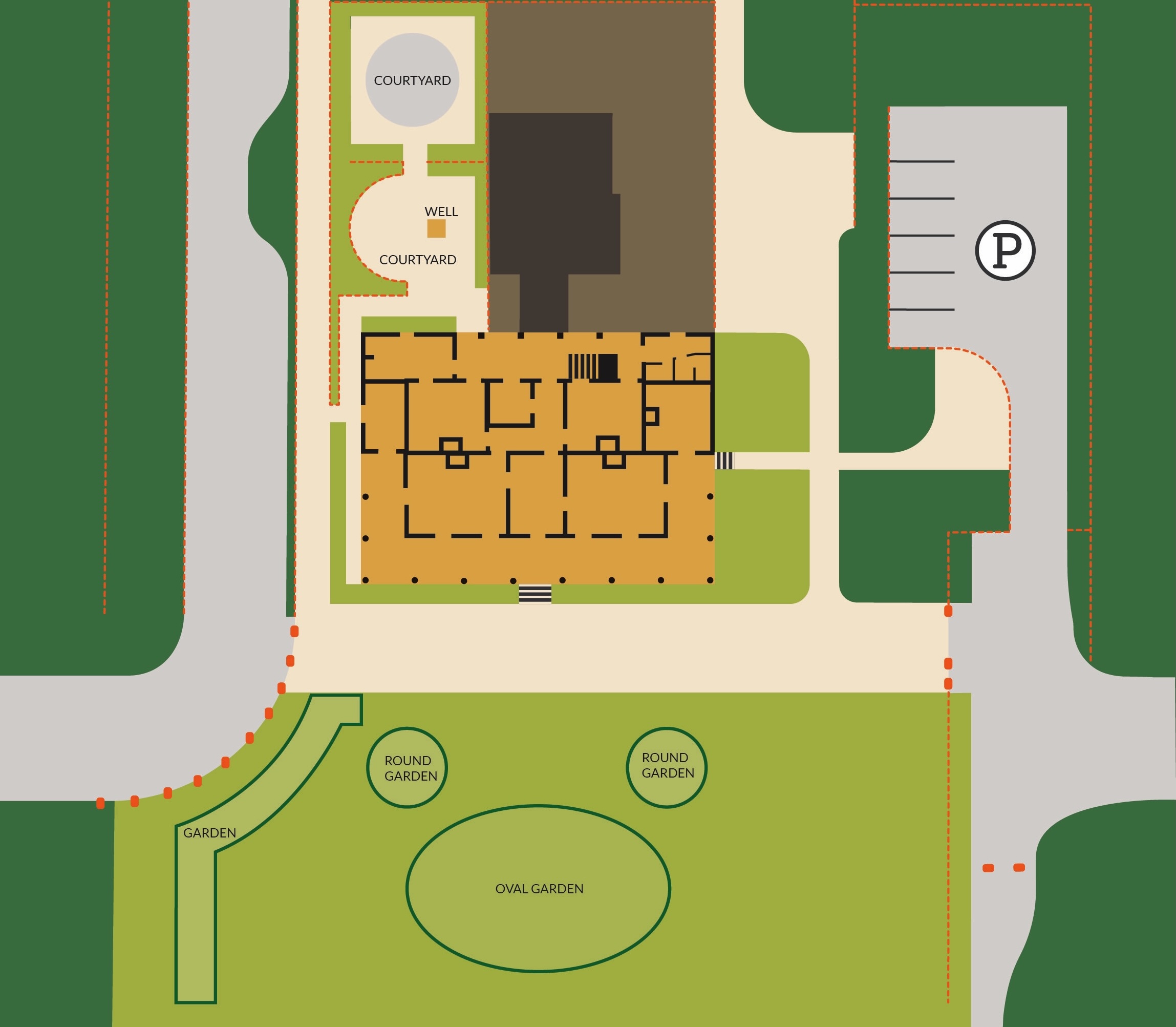
The Front Entrance — walking back from the rear garden
The third voice on this tour belongs to no one in particular — an unnamed historian who works with what the site has left behind. Where Elizabeth and Harris speak from inside their own lives, the historian steps back: to ask what buildings remember, what records leave out, and what it means to preserve something at all.
Unlike the others, this voice is entirely imagined. But the questions it raises are real ones that historians and conservators have genuinely grappled with at this site.
Head back to the front entrance of the cottage, where the tour began.
Transcript
Vincent - The Unknown Historian
Two voices on this tour belong to people who lived here. Elizabeth Ruse and John Harris. One worked the soil. One built the estate around it.
Vincent - The Unknown Historian
They had the certainty that comes with being in the middle of a thing. I don't have that. I work with what's left — and what's left is, honestly, more interesting than either of them could have known.
Vincent - The Unknown Historian
Buildings like this don't sit still. They never did. That's the first thing I'd want anyone to understand before going inside. We talk about a cottage from 1790, or a cottage from 1835, as if there were a single moment when someone stood back, wiped their hands, and said there, finished. That moment doesn't exist.
Vincent - The Unknown Historian
The cottage you're walking around was repaired through the 1880s, leased and let and loved and neglected by turns, cracked open by an earthquake in 1989, restored in the 1990s with a new roof and reconstructed verandah columns. Eleven owners. At least that many tenants. By the time it became a museum it had already lived a dozen different lives.
Vincent - The Unknown Historian
And we still don't know exactly when it was built. There's been a debate going on for more than a century. Some historians have called it Australia's oldest surviving house — older even than the famous neighbour. Others, looking at the brickwork, the form of the rooms, the way the building sits across the slope, place it firmly in the 1830s instead.
Vincent - The Unknown Historian
Both arguments are serious. Neither has won. And I'll tell you what I find genuinely lovely about that: it does not, in any way, diminish what this place is. The land under your feet is the first land grant ever issued in Australia. That fact does not require the building to be a particular age. The building can stay mysterious. The site can stay luminous. Both, at once.
Vincent - The Unknown Historian
The very first house the National Trust of Australia ever bought in New South Wales was this one, in 1961 — a building no one could date, on a piece of ground whose meaning was never in doubt. They began their work with a question, not an answer. To me, preservation isn't about freezing a moment in time. It's about keeping the conversation going long enough for the next people to have it too.
Vincent - The Unknown Historian
The house is still here. Go in, if you'd like. It still has things to say.
This article was narrated using AI technology.
Learn more →
Questions & Answers
Optional follow-ups, a minute or two each.
Reused Bricks
Transcript
Anna
I'm curious about the brickwork. You can actually date bricks — the mix,
the kiln method, the dimensions all shift over time. So if the bricks in this building
turn out to be older than the 1830s, doesn't that settle it? Doesn't that push the
date back?
Vincent - The Unknown Historian
It proves they're old bricks.
Anna
That's it?
Vincent - The Unknown Historian
That's where it starts, yes.
Vincent - The Unknown Historian
The problem is provenance. A brick doesn't carry a certificate saying I was made for this building, laid in this wall, and have been here ever since. What you can date is when the brick was fired. What you can't determine from the brick alone is when — or where — it was first used.
Vincent - The Unknown Historian
In early colonial construction, salvage was completely standard. Nothing was wasted. You demolished one building, you pulled the bricks, you cleaned the mortar off, and you used them again. The colony didn't have the surplus to throw materials away. So finding bricks in this building that were fired in the 1790s tells you exactly what it sounds like: at some point, someone fired those bricks. What it doesn't tell you is whether they went straight into this wall, or sat in a kiln-yard for years, or came out of an earlier structure that was cleared from this very site.
Anna
So it can't settle the date.
Vincent - The Unknown Historian
Not on its own. It's one thread in a larger argument, and a fragile one. If you found only early bricks — consistent across the whole structure, no mixing — that would be more interesting. What you'd expect in an 1830s building that incorporated salvaged material is exactly what's there: a mixture. Which is consistent with either hypothesis.
Vincent - The Unknown Historian
This is the thing about material evidence. It gives you information about materials. You still have to argue about the building.
Ruse Street
Transcript
Benji
I'm curious about what used to be out the front. Ruse Street — you can
still see the grade where it sat, lower than the current ground level. The Trust
removed it in 1999, put the carriage drive back. What do you actually lose when you
do that?
Vincent - The Unknown Historian
More than most people realise. And less than some would claim.
Vincent - The Unknown Historian
What you gain is obvious: you reinstate the approach the cottage was designed for. The carriage drive came in from the west on its original alignment. They replanted the olive avenue — there's photographic evidence going back to the Fraser tenancy that it was there. They rebuilt the garden beds from an 1871 nursery catalogue. Purchase's Somerset Nursery, which operated right next door to this property. If you wanted to know what plants were genuinely available in this district in the 1860s and 1870s, that catalogue is about as close as you get to a primary source.
Vincent - The Unknown Historian
So the work was rigorous. I want to be clear about that. This wasn't a romanticised guess.
Benji
But Ruse Street was there for a hundred and thirty years.
Vincent - The Unknown Historian
It was. And that's exactly what I mean.
Vincent - The Unknown Historian
The suburban street that ran past this front fence — with its kerb, its grade, its particular relationship to the neighbourhood that had grown up around it — that was also a historical layer. It documented what happened to this place after the estate era ended: the subdivision, the encroachment, the slow absorption into the ordinary fabric of Parramatta. The Trust chose to remove that layer in favour of an earlier one. Which is a defensible choice. Heritage conservation always involves deciding which era to speak for.
Vincent - The Unknown Historian
But I think it's worth sitting with what that means. The 1999 works didn't reveal the past. They CONSTRUCTED a version of it. One that's historically grounded — but still a choice.
Benji
So there's no neutral option.
Vincent - The Unknown Historian
There isn't. A decaying site makes a choice. A restored site makes a different one.
The only thing you can't do is stand still.
On fiction and historical accuracy
This stop presents a fictional scene — a character who may or may not have existed, a conversation that was never recorded, a moment invented to bring the past within reach. That is a deliberate choice. History rarely preserved the voices of the people who mattered most here: the labourers, the women, the convicts, the Dharug families whose Country this always was. Fiction lets those voices speak.
The invention, though, is held on a short leash. Every detail of setting, season, diet, law, and daily life has been checked against the historical record. Where the evidence is uncertain, we have tried to say so. Where it is solid, we have built on it faithfully.